
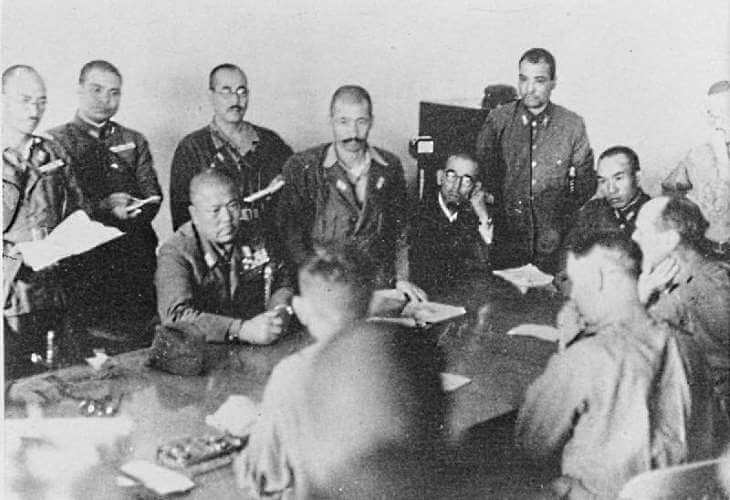
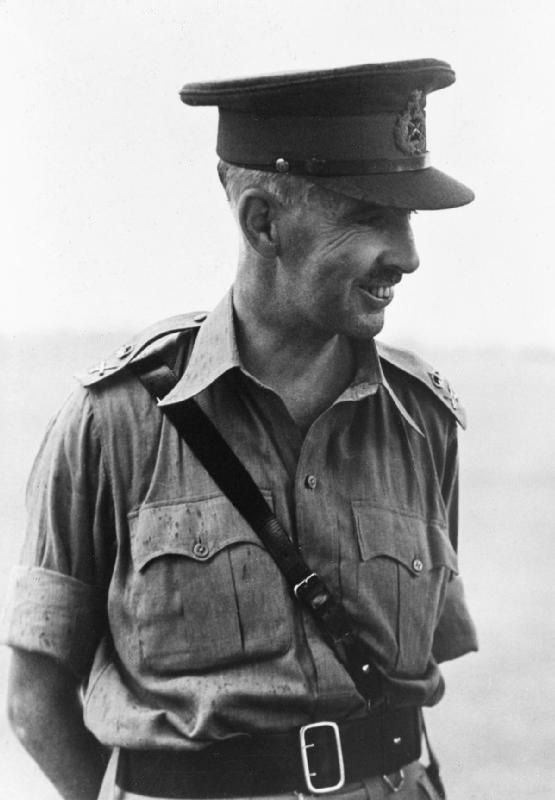
On the morning of 15 February 1942, Lieutenant General Arthur Percival surrendered to the Japanese lines in Singapore. The surrender marks the fall of Singapore. Behind him lay 85,000 British, Australian, Indian, and Malayan soldiers garrisoning in the “impregnable fortress of Singapore. Ahead of him lay Tomoyuki Yamashita, a general who just conquered 700 miles of Malayan Peninsula with a force outnumbered three to one.
Japan’s success does not rely on its tanks, naval bombardment or overwhelming firepower that brought down Singapore. Bicycles became the secret weapon of Japan’s 25th Army, which enabled the Japanese troops to move swiftly down Malayan roads. In one of the most audacious and innovative military campaigns in history, Japan conquered the entire Malay Peninsula and Britain’s greatest Asian stronghold in just 70 days.
The fall of Singapore inflicted a psychologically devastating defeat on the British and would ultimately mark the end of the British Empire in Asia. This is the full story of the Fall of Singapore — the strategy, the blunders, the bicycles, and the consequences that reshaped Southeast Asia forever.
The “Impregnable Fortress”: British Malaya Before the Invasion
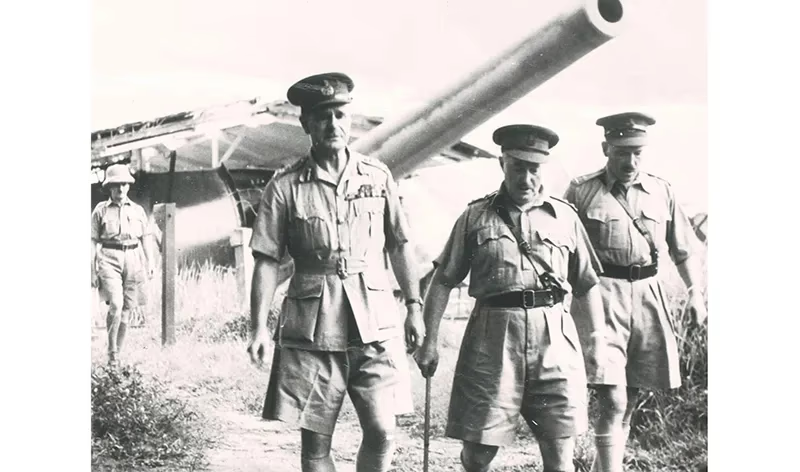
To understand how Singapore fell, you first need to understand the extraordinary degree of British complacency that made the fall possible. A complacency so total it borders on the incomprehensible in hindsight.
Key Facts: Fall of Singapore at a Glance
| Campaign dates | 8 December 1941 – 15 February 1942 |
| Duration | 70 days |
| Japanese commander | Lieutenant General Tomoyuki Yamashita |
| Allied commander | Lieutenant General Arthur Percival |
| Japanese forces | ~30,000 men (25th Army) |
| Allied forces | ~85,000–100,000 troops |
| Outcome | Japanese victory — largest surrender in British military history |
| POWs taken | 100,000+ Allied troops |
| Churchill’s verdict | “The worst disaster in British military history” |
Singapore strategy – Defending from the sea
Throughout the 1930s, Japan’s military ambitions in Asia grew increasingly obvious. To overcome Japan’s threat, Britain came out with a plan they called the Singapore strategy. The plan was simply to turn Singapore’s naval base into the anchor of British power in Asia. The Royal Navy would intercept and destroy Japanese forces before they reached the island.
The strategy rested on two assumptions. First, Japan would attack from the South, across the South China Sea. Second, the invading army would march through the Malay Peninsula, that consist of 700 miles of dense jungle, mangrove, swamp and rivers. Many defence planners believe that the second option would block any invasion attempts. However, both assumptions would prove catastrophically wrong.
British underestimation of Japan
The most enduring symbol of British strategic failure at Singapore is the image of the great coastal defence guns. These guns, weighing nearly a ton and pointing southward toward the sea. The popular myth that these guns “could not be turned around” to face the Japanese advancing from the north is not entirely accurate. Most of the guns could traverse, but they only use largely armour-piercing ammunition, designed for naval targets, not the high-explosive shells needed against infantry and jungle positions.
The state of British Malaya
Racial arrogance became the most damaging factor before the fall of Singapore. The British military planners consistently underestimated Japanese military capability. They often dismissing Japanese soldiers as physically inferior, technologically backward, and incapable on conducting modern and sophisticated warfare that the coming campaign would demonstrate.
Malaya had almost no defences and quickly fell to the superior fighting skills of the Japanese. The assumption that the jungle was impassable was itself a product of this arrogance — the British could not imagine that an army they considered primitive would master jungle warfare more effectively than they had.
Japan’s Masterplan: Yamashita, Tsuji, and the Taiwan Army Research Unit
While British planners congratulated themselves on their impregnable fortress, Japanese planners diligently did their homework with meticulous thoroughness.
General Tomoyuki Yamashita — the Tiger of Malaya
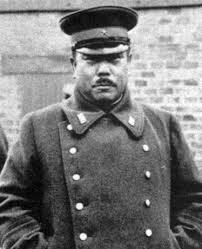
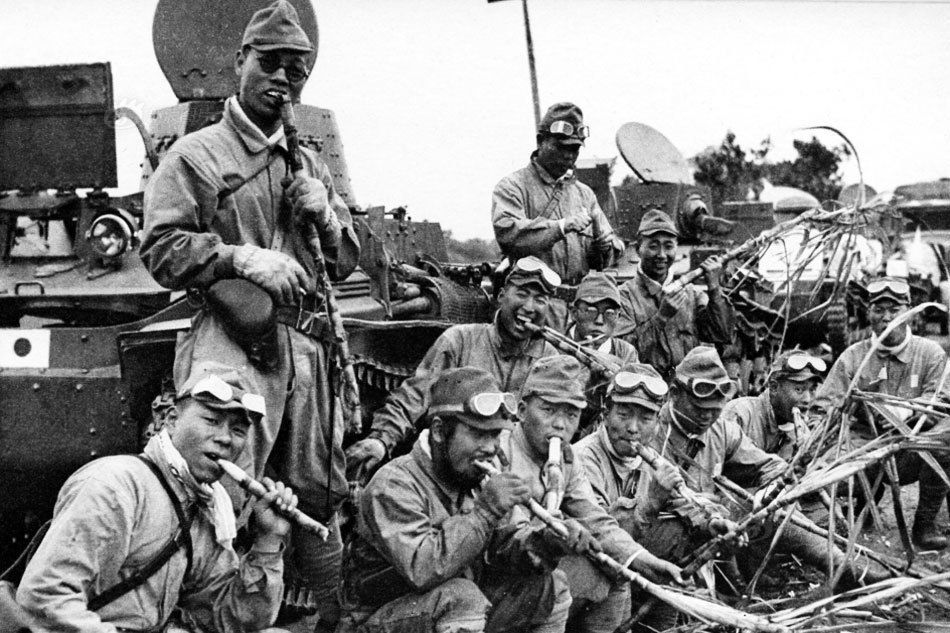
Lieutenant General Tomuyuki Yamashita considered by many to be one of the most formidable military commanders of the Second World War. General Yamashita believed in speed, surprise, and relentless forward momentum (similar to Blitzkrieg). Japan high command gave Yamashita command of the 25th Army of the Malayan campaign and tasked him with one of the most ambitious military objectives of the Pacific war — the conquest of Malaya and Singapore within 100 days. He would do it in 70.
Yamashita’s main concern in this campaign caused by the protracted fight for Singapore. He had good cause to worry since he knew that he could lose the upcoming battle for several reasons. Before the battle of Singapore, Yamashita lost over 4,500 personnel, and his remaining men would have their hands full when facing roughly 100,000 defenders of Singapore. The key to his strategy relies on speed and not firepower.
Colonel Tsuji’s Taiwan Army Research Unit — solving jungle warfare
The intellectual architect of Japan’s Malayan campaign was Colonel Masanobu Tsuji. Colonel Tsuji known as an arrogant, brilliant, and ruthless officer who headed a small but enormously consequential research unit in Formosa (Taiwan) in 1941. Tsuji and his men worked out tactics and logistics, often going out into Formosa’s jungles to test their theories.
The unit studied every aspect of tropical campaigning — diet, disease, equipment, tactics, logistics and produced detailed recommendations that would give Japanese forces a decisive edge in the Malayan jungle. One of the unit’s most consequential recommendations was the bicycle. The Japanese planners understood that the Malay Peninsula’s road network would be its military spine. Horses would be unsuitable for the tropical heat. Meanwhile, motorised transport consumed precious fuel and was vulnerable to destroyed bridges and jungle obstacles. Bicycles would be the solution for Japan’s military campaign in Malaya.
Intelligence and preparation — Japan knew Malaya better than Britain did
Japan’s intelligence preparation for the Malayan campaign was extraordinary. Japanese agents had been gathering detailed information on British defences, road networks, and troop dispositions for years before the invasion. When the Japanese received British defence documents, they initially thought they were fakes. But when they compared them with what their spies reported in Malaya, they were amazed. Japan understood British Malaya better than the British defenders did — a decisive advantage that no amount of numerical superiority could overcome.
The Bicycle Blitzkrieg: How Japan’s Two-Wheeled Army Conquered Malaya
This is the story that has never been told quite the way it deserves to be — how 12,000 Japanese soldiers on bicycles outmanoeuvred one of the largest colonial armies in Asia.
Why bicycles — speed, silence, fuel-free, and jungle-ready
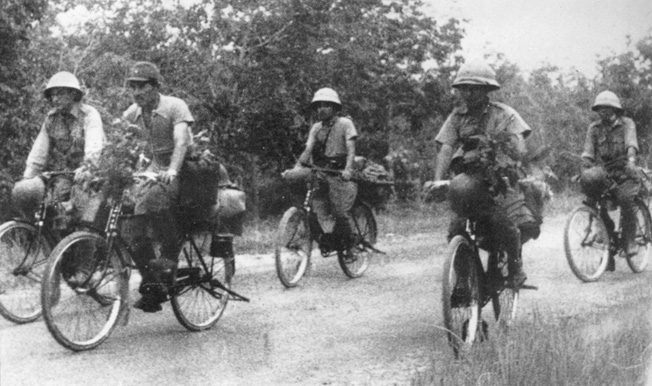
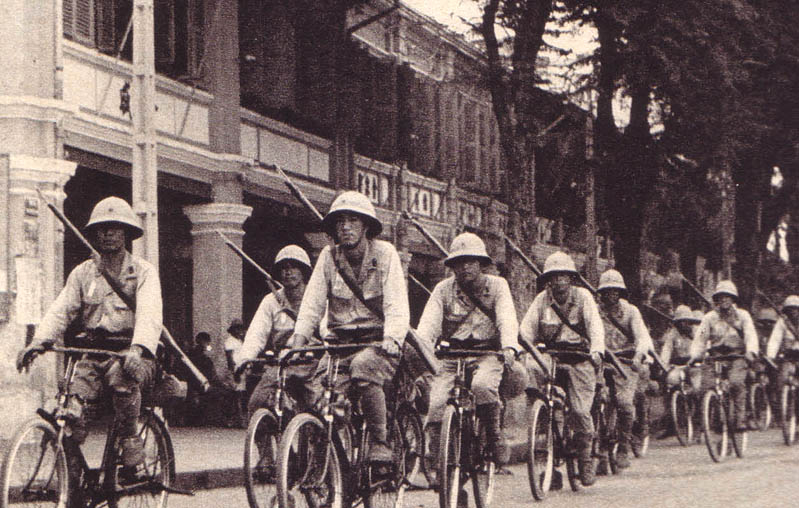
Bicycles also allowed the Japanese to get around the country without using fuel. The troops were able to use hidden paths to get around, on top of well-paved main roads. The bicycles could be easily transported, allowing soldiers to cross rivers by carrying them on their shoulders or over small bridges destroyed by their engineers. Their use in the field also meant the Japanese could carry far more supplies than their enemies, who had to transport items on their backs.
A Japanese soldier on a bicycle covered ground three to four times faster than an infantry soldier on foot. When British forces retreated and blew up a bridge to slow the Japanese advance, Royal Engineers destroyed over a hundred bridges during the retreat, which did little to delay the Japanese. Japanese engineers repaired bridges within hours, or soldiers simply carried their bicycles across rivers on their shoulders. The Commonwealth, having thought the terrain made them impractical, had no tanks and only a few armoured vehicles, which put them at a severe disadvantage.
Flat tyres and improvisation — the squeaking ghost army
One of the campaign’s most vivid details speaks to the extraordinary resourcefulness of Japanese forces. As the advance accelerated and thousands of bicycles accumulated punctures from the rough Malayan roads, Japanese soldiers found a creative solution: they simply removed the inner tubes and rode on the rims. The resulting noise, thousands of metal rims clattering on tarmac, created an eerie, unsettling sound that Allied soldiers recalled long after the war. Some accounts describe the noise as resembling the advance of tank columns, adding to the psychological terror of the Japanese advance.
Speed of advance — 700 miles in 70 days
Within four days of their landing, the 5th Division had advanced from Singora through the town of Jitra to capture the RAF airfield at Alor Setar. By 11 January 1942, barely a month into the campaign, Japanese forces had captured Kuala Lumpur. The Japanese forces never relented. Town after town, airfield after airfield fell in rapid succession, each retreat by Allied forces giving the Japanese new momentum and new supplies.
The Malayan Campaign: Key Battles and the Retreat South (December 1941 – January 1942)
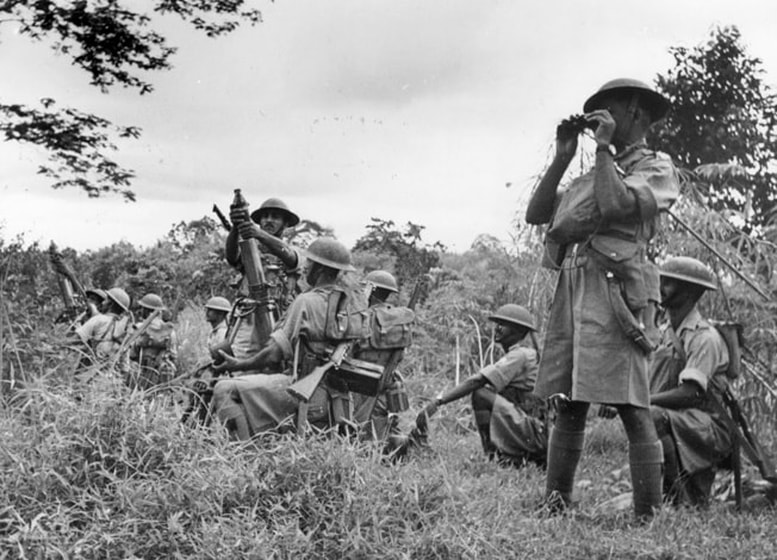
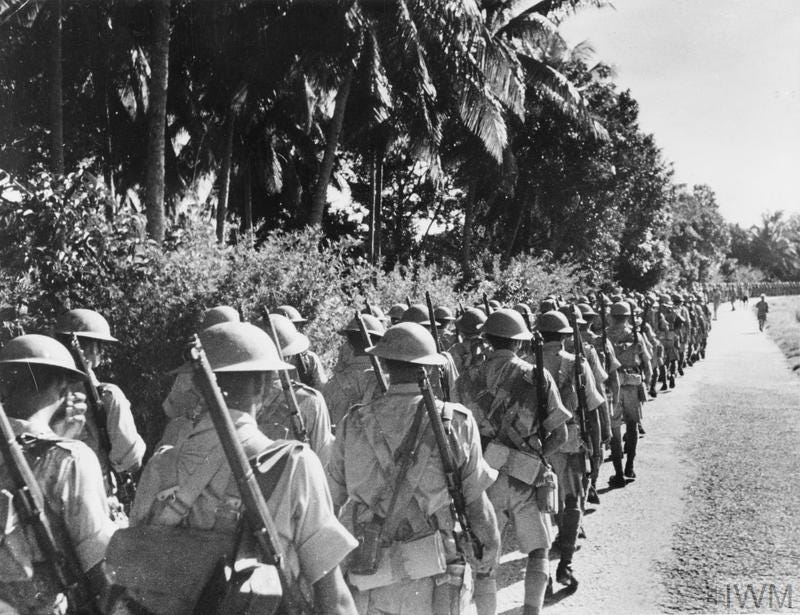
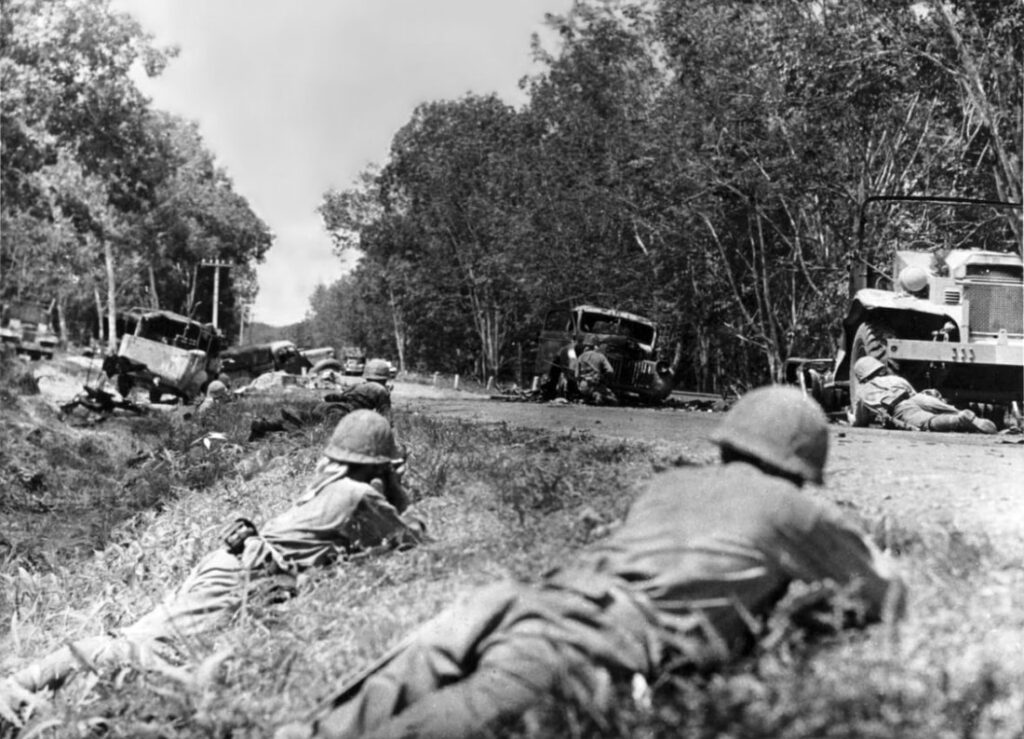
8 December 1941 — invasion begins at Kota Bharu and Pearl Harbor simultaneously
The invasion began on December 8, 1941, just hours after the surprise attack on Pearl Harbor. The Japanese, primarily made up of soldiers from the 25th Army, swiftly advanced from their position in Thailand and successfully invaded British-controlled Malaya. Japan calculated that the shock of Pearl Harbor would paralyse Allied decision-making in the critical first hours. The calculation proved correct.
Sinking of HMS Prince of Wales and HMS Repulse — air supremacy lost
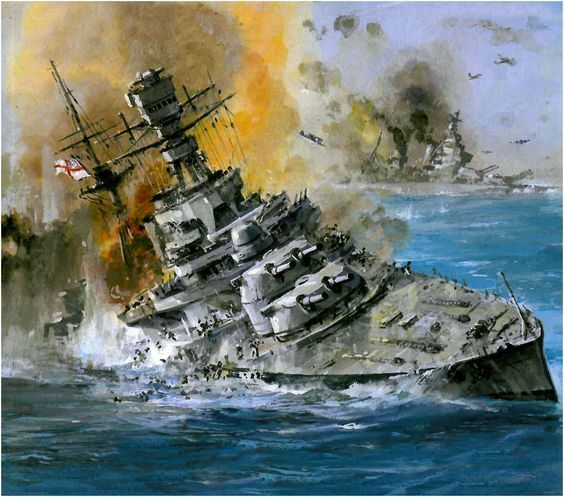
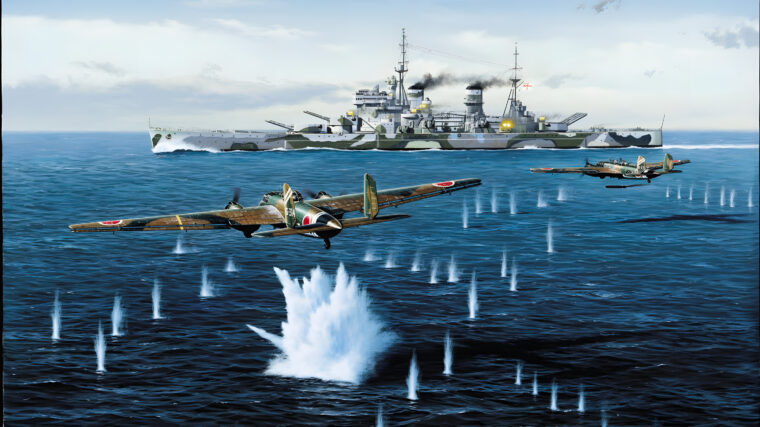
Two days after the invasion began, the Royal Navy suffered a catastrophic blow. The battleship HMS Prince of Wales and the battlecruiser HMS Repulse had been sent north from Singapore to intercept Japanese landing forces. Japanese land-based aircraft found and sank the two capital ships on 10 December, leaving the east coast of the Malayan Peninsula exposed and allowing the Japanese to continue their amphibious landings. At a stroke, Britain lost its naval deterrent in the Pacific. The waters around Malaya fell under Japanese control.
The fall of Jitra — first British defensive line collapses
The first major British defensive position during the Malayan campaign, located in Northern Kedah. This position known as the Jitra Line and supposed to hold the Japanese invasion for at least a month. However, the defense collapsed in only two days due to Japanese forces’ tactics of frontal pressure and deep flanking movements through the jungle. The 11th Indian division, exhausted and shaken, began their long retreat that would not stop until Singapore.
The fall of Penang — the moral collapse of British rule
The evacuation of Europeans from Penang, with local population being left caused embarrassment for the British Empire. Historians judged that the collapse of British rule in Southeast Asia came not at Singapore but at Penang. The abandonment of Penang’s Asian population by the British officials, shattered whatever remained of the myth of British imperial benevolence. It was considered by many Malayans of racial betrayal that the people would not forget.
Kuala Lumpur falls — 11 January 1942
After the embarrassment fall of Penang, the Japanese entered and occupied Kuala Lumpur on 11 January 1942. Singapore Island was now less than 200 miles away for the invading Japanese army. The speed of the advance had broken Allied morale comprehensively. Units that had never been given a chance to establish a coherent defensive line were retreating faster than commanders could organize replacements. The campaign had the character of a controlled collapse — British forces falling back, blowing bridges that barely slowed the Japanese, and retreating again.
The Battle of Muar and the Last Stand — Adnan Saidi’s story
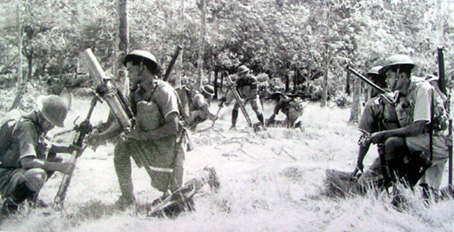
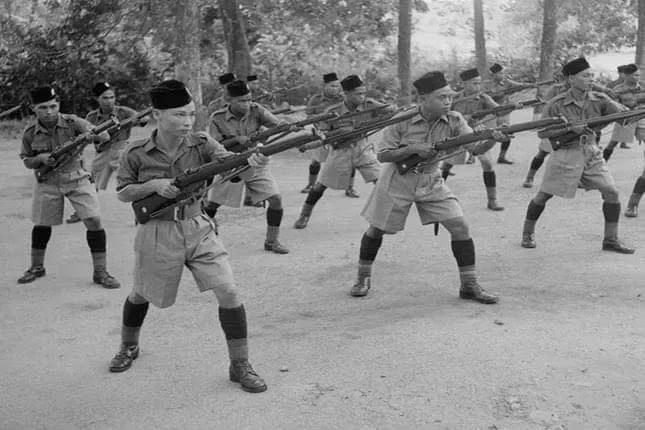
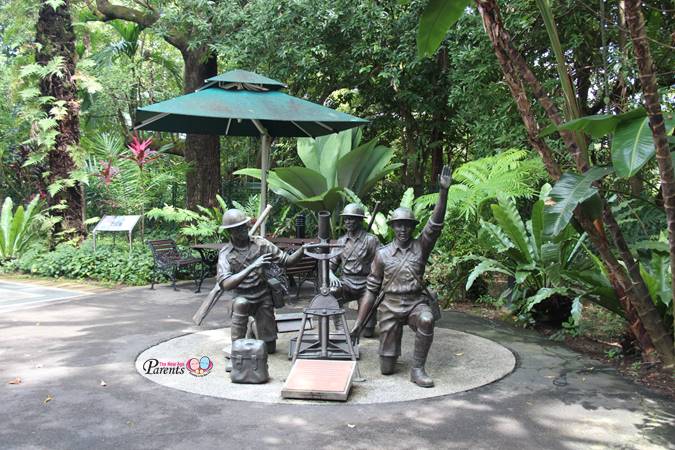
Among many desperate resistance during the Malayan campaign, there few heroic moment, few were more heroic than the fighting at Bukit Chandu. During the battle, Lieutenant Adnan Saidi and the Malay Regiment made their last stand against overwhelming Japanese forces. Adnan’s story and sacrifice became one of HistoFreak’s most powerful articles, His sacrifice became important part of Malayan campaign. Under Adnan’s leadership, the Malay soldiers hold their ground to the last breath as their position he defended crumbled around him. Read the full story in our dedicated article on Adnan Saidi: The Last Defender of Malaya.
Retreat across the Causeway — 31 January 1942
On 31 January 1942, the last Allied troops crossed the Causeway into Singapore. Behind them, engineers blew a 70-foot gap in the causeway linking Johor to Singapore Island. The gap slowed the Japanese for approximately a week. The Japanese engineers bravely repaired it under fire, and on the night of 8 February 1942, Yamashita launched his assault on Singapore Island itself.
The Battle of Singapore: The Final Siege (February 1942)
88,000 shells in 15 hours — the Japanese bombardment
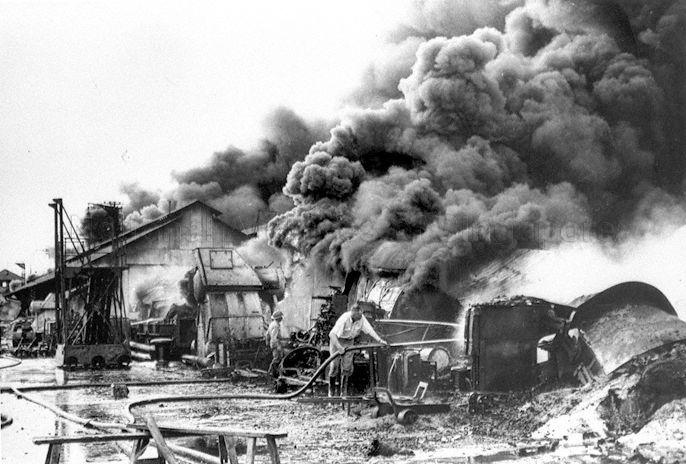
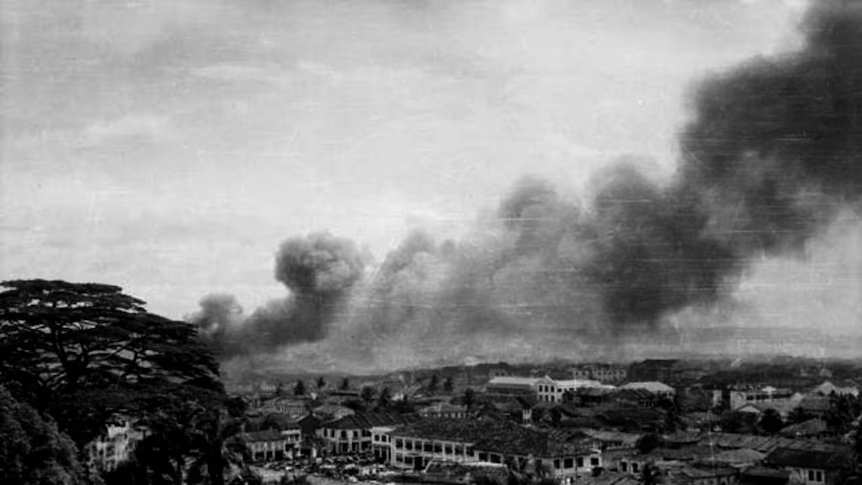
Before the crossing, Yamashita’s artillery bombarded Singapore with devastating effect. Over the next 15 hours, starting at 23:00 on 8 February 1942, Yamashita’s heavy guns fired a bombardment of 88,000 shells along the straits. The bombardment successfully severed communications of the Allied forces and commanders, as Japanese assault troops began crossing the Johor Strait in the darkness.
The crossing of the Johor Strait — northwest not northeast
The British-led Allied High Command convinced that the main attack would come from the northeast. Consequently, the fresh and full-strength British 18th Division was placed in this area. The Australian 8th Division, weakened after fighting in the Malayan campaign, placed in the north-west side of Singapore Island. Yamashita attacked precisely where the weakest defenders located, sparsely defended by exhausted Australian troops. By the time Allied commanders recognized their mistake, Japanese forces had established a firm beachhead and were advancing rapidly inland.
The Alexandra Hospital massacre
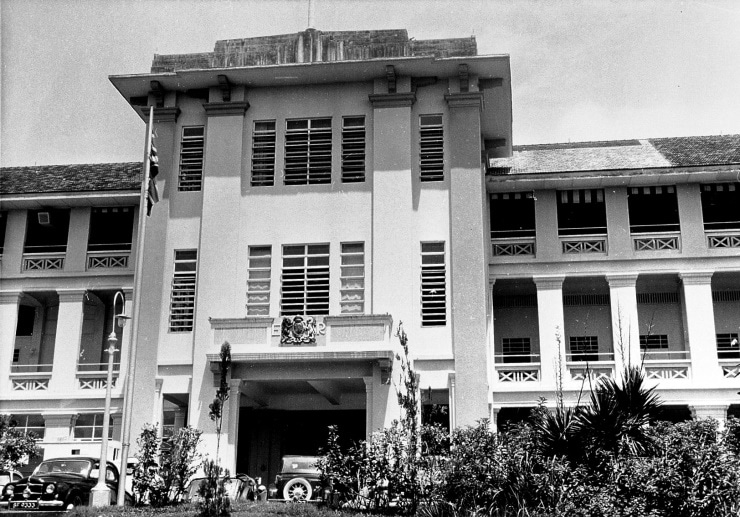
Among the darkest episodes of the entire campaign, massacre at Alexandra Military Hospital became the darkest moment of the campaign. A British Lieutenant acting as an envoy with a white flag approached Japanese forces killed instantly with a bayonet. After Japanese troops entered the hospital, they killed up to 50 soldiers, including some undergoing surgery, including doctors and nurses. About 200 male staff members and patients were assembled, bound, and ordered to walk to an industrial area. Those who fell on the way were bayoneted. The men were forced into a series of small, badly ventilated rooms where they were held overnight without water. The atrocity shocked Allied troops across the island and hardened attitudes toward the Japanese occupation that would follow.
Water runs out — the decision to surrender
By the morning of 15 February 1942, the military situation was beyond recovery. There was only enough water supply for 24 hours due to breaks in the water mains and pipes. The main reservoirs were all in Japanese hands. Casualties from enemy bombing were increasing faster than the rate at which bodies could be collected and there was only three days’ worth of rations.
On the Japanese side, Yamashita extremely worried that the British would discover the truth about his own actual situation. Particularly in his numerical inferiority and shortage of supplies and ammunition. In a remarkable historical irony, both sides were on the verge of collapse simultaneously. Yamashita banged his fist on the table and demanded unconditional surrender, bluffing with almost no cards left to play. Percival, unaware of how desperate the real Japanese condition, decided to surrender Singapore to Japan.
15 February 1942 — Percival surrenders to Yamashita at the Ford Factory
On the morning of 15 February, Percival met his commanders at the Fort Canning Bunker. In light of the circumstances, Percival decided to surrender. Later that day, Percival and his party met Yamashita in the Japanese headquarters located at the Ford Factory in Bukit Timah and officially surrendered Singapore to the Japanese forces. Prime Minister Winston Churchill called it the worst disaster in British military history. More than 100,000 troops became prisoners of war, together with hundreds of European civilians. It had taken Japan exactly 70 days to accomplish what the British think as impossible.
Legacy: How the Fall of Singapore Changed Malaya, Asia, and the British Empire Forever
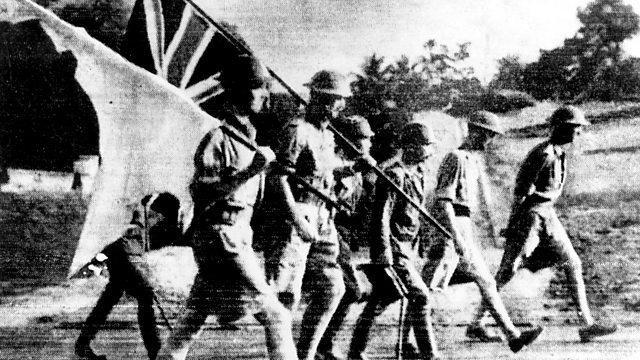
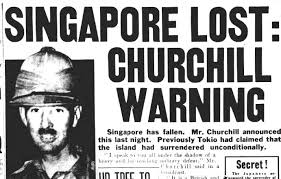
British commanders consistently failed to understand or respect Japanese military capability. They dismissed intelligence reports about Japanese jungle training, underestimated the bicycle strategy, and assumed that urban and naval warfare would determine the campaign’s outcome. Japanese commanders, by contrast, knew the terrain, the roads, and the British defensive dispositions in extraordinary detail.
The deepest cause of Singapore’s fall lies on the racial arrogance of the British High Command toward the Japanese forces. The assumption of Japanese soldiers’ inferiority to European troops, led directly to the underestimation of Japanese capability that made every other failure possible. It was an arrogance that cost 100,000 men their freedom and thousands their lives.
The Sook Ching massacre — Japanese purge of Chinese Singaporeans
After the fall of Singapore, the Japanese military police or Kempeitai launched operation Sook Ching. This operation targeted the population of the Chinese Singaporean. The Japanese killed between 25,000 and 50,000 ethnic Chinese civilians in mass executions across Singapore and Malaya. The operation was motivated by Japanese hostility toward Chinese Singaporeans who had supported China’s resistance to Japanese aggression. The Sook Ching massacre remains one of the darkest chapters of the Japanese occupation and a wound in Singaporean Chinese memory that has never fully healed.
Three and a half years of Japanese occupation
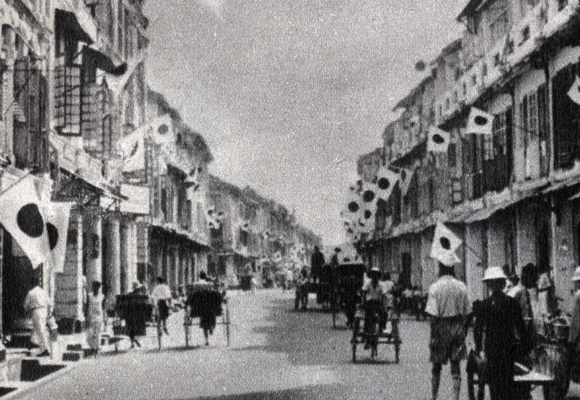
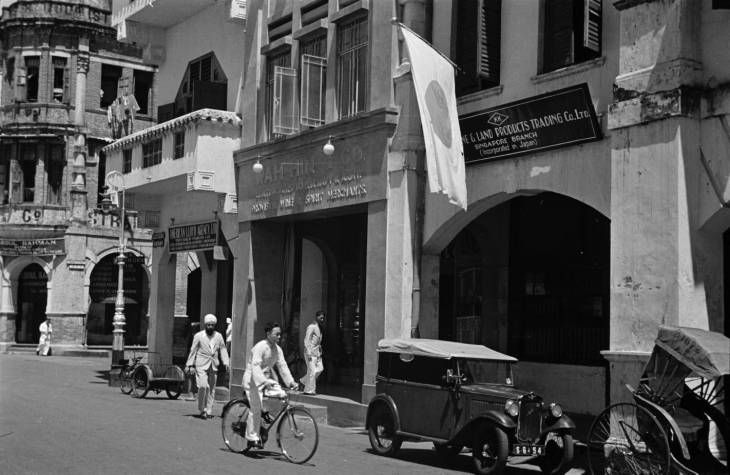
The Fall of Singapore subjected the island to three-and-a-half years of Japanese occupation. Japan renamed Singapore “Syonan-To” or Light of the South. The Japanese administered it as a military territory under the Kempeitai military police. The occupation marked by forced labor, food shortages, systematic brutality, and the exploitation of local populations across Malaya and Singapore for Japan’s war economy. An estimated 100,000 people in Singapore were taken prisoner, some 9,000 of whom were said to go on to die building the Burma-Thailand railway.
End of British imperial prestige — Asia would never be the same
The fall of Singapore severely undermined British prestige in Asia, which contributed to the end of British rule in the region. The image of 85,000 Allied soldiers surrendering and the abandonment of Asian populations, destroyed the myth of European racial and military superiority among the local Malayan population. Across Southeast Asia, independence movements that had been slowly building gained enormous momentum from the demonstration that European colonial powers were not invincible. Malaya would gain independence in 1957, Singapore in 1965.
The bicycle lesson — innovation beats tradition in warfare
The “Bicycle Blitzkrieg” proved that in modern warfare, adaptability is more valuable than armor. Japan did not win the campaign because it had more men, more weapons, or more resources — it had fewer resources compared to the British. It won because they understood the terrain, adapted its tactics to the environment, and moved faster than its enemy could respond.
It is a lesson that has been relearned in conflicts from Vietnam to Afghanistan — and one that the British army of 1941, locked into its assumptions about European-style warfare, was fatally unwilling to consider. The Fall of Singapore remains one of history’s most dramatic military reversals. It had taken the Japanese just 70 days to crush the British Empire forces in Singapore and Malaya. Southeast Asia would never be the same again and neither would the British Empire.
For more on the broader context of colonial Southeast Asia, read our articles on British Malaya, the heroic last stand of Adnan Saidi, and the History of Bangkok during the same wartime period.
References
NUS Press (2017) 1942 Fall of Singapore. Available at: https://nuspress.nus.edu.sg/collections/1942-fall-of-singapore
Inside Story (2021) The fall of Singapore. Available at: https://insidestory.org.au/the-fall-of-singapore/
National Museum of Singapore (2018) Fall of Singapore. National Archives of Australia. Available at: https://www.nma.gov.au/defining-moments/resources/fall-of-singapore
Journal of Military and Veterans’ History (2025) Editorial: The fall of Singapore in 1942. Available at: https://jmvh.org/article/editorial-24/
Farrell, B.P. (2005) The Defence and Fall of Singapore, 1940–1942. Stroud: Tempus Publishing. ISBN 0-7524-2311-8