

The modern Philippine state shaped by successive colonial powers—most notably Spain, followed by the United States and Japan. Among these, Spanish rule left the deepest and most enduring imprint, reshaping the nation’s political structures, social hierarchy, religion, and cultural identity over more than three centuries.
As a result, the Philippines can be understood as an imperial artifact: a nation whose institutions, beliefs, and collective identity emerged from layered experiences of colonial rule rather than from a single indigenous state tradition.
To begin with the name “Philippines”, the name reflects to its colonial origins. Formerly known as Las Islas Filipinas, the archipelago later named after King Philip II by the Spanish explorers shortly before the Spanish occupation in 1565. Before the Spanish rule, the islands have no major existing political or cultural entity known as the “Philippines.”
Unlike many parts of Southeast Asia, the islands were never unified under a single culture or major Asian empires such as Majapahit, Srivijaya, the Malacca Sultanate, or Siam. This highlights how the Philippine nation emerged largely through colonial rule rather than from a unified pre-colonial state.
Spanish Arrival and the Philippine colonization

Spain’s involvement in the Philippines began in 1521 under Ferdinand Magellan. Under the Spanish crown, he reached the archipelago to find a westward route to the spice islands. His arrival did not immediately lead to Spanish colonization, particularly due to his death at the Battle of Mactan.
During the battle, a local chieftain Lapu-Lapu killed Magellan and became a Filipino national hero. Despite Magellan’s failure to establish Spanish control, his voyage placed the islands firmly on Spain’s imperial map and revealed their strategic potential.
Spanish Conquest of 1565: The start of Colonial Rule


The Philippine colonization began in 1565 with the arrival of Miguel López de Legazpi, who successfully established Spain’s first permanent settlement in Cebu. Unlike the initial expedition, Legazpi’s mission combined military force, diplomacy, and alliance-building with local leaders, allowing Spain to secure lasting control.
From this foothold, Spanish authority expanded across the archipelago, leading to the capture of Manila in 1571. The city of Manila later became the political and administrative center of the Spanish rule. This moment marked the formal beginning of more than three centuries of Spanish colonial in the archipelago.
Spain’s objectives in the Philippines reflected the broader ambitions of its global empire. Its primary goal was to spread Roman Catholicism and bring the islands into the Christian world. Equally important was the pursuit of strategic and economic interests, including the control of trade routes (Manila-Acapulco Galleon Trade) and resources, particularly to counter Portuguese and Dutch influence in Southeast Asia.
Spanish Colonial Influence on Modern Philippines
Spanish colonization shaped the country’s religion, governance, economy, culture, and social structure. While the Spanish empire ruled from afar, its colonial policies left deep and lasting influence to modern Philippines and Filipino identity. From Catholicism to surnames, centralized governance to social hierarchy, the Spanish era remains a solid foundation in shaping modern Philippines.
Catholicism in the Philippine Colonization


One of Spain’s most significant legacies in the Philippines was the conversion of the local population to Catholicism. Spanish missionaries including the Augustinians, Franciscans, Dominicans, and Jesuits played a vital role in the conversion. Compared to South America, Spain used churches rather than military force as a tool of control and integration in the Philippines.
By the end of Spanish rule, the Philippines had become the only predominantly Christian nation in Asia. Catholicism became deeply embedded in Filipino identity, shaping daily life and moral values of the community. Religious practices such as baptisms, fiestas, weddings, and funerals become a common practice in the country.
Despite mass conversion, pre-colonial animist beliefs remains widely in the country. Instead, they blended with Catholic practices, creating a unique form of Christianity. Indigenous spirits replaced with saints, while rituals and festivals incorporated local traditions.
Catholic Festivals and Holidays in the Philippines
According to historical record, Ferdinand Magellan persuade the local ruler, Raja Humabon to pledge allegiance to Spain. Later, the raja converted into catholic. At the end of the baptism, the Spanish presented them with a wooden statuette that depicted Jesus as a child, which later became the symbol of the Christianity’s arrival in the Philippines.
Over time, Catholicism took root and spread across the archipelago. The Feast of Santo Niño, celebrated on the third Sunday of January, commemorates this historic event rather than the Spanish conquest. The celebration centered on family, food, and devotion, it features lively parades in Which Filipinos display and carry their own statues of Jesus. It creates a colorful and joyful tradition comparable to Christmas celebrations.
Colonial Governance influencing modern Philippines
The Spanish empire introduced a centralized colonial administration led by a Governor-General in Manila. The Governor-General acting as the king’s representative, making Manila the political center of the archipelago. This system replaced fragmented pre-colonial system with a unified authority, establishing patterns of centralized governance that persist in the modern Philippine state.
Under the Spanish rule, colonization transformed the Philippines from scattered barangays and sultanates into a single colonial entity. The colonial government reorganized the provinces, with taxation and new laws imposed in the archipelago. This unification laid the groundwork for the modern Philippine nation-state, despite being originally designed to serve colonial interests.
Colonial Economy and Creation of Social Hierarchy
Like other European power, Spain also focus on trade monopolies and extractive systems that discourage industrial development. The economy revolved around agriculture, tribute, and imports, patterns that later contributed to inequality and underdevelopment. Modern economic challenges, including reliance on imports and unequal wealth distribution, can be traced back to the colonial time.
Manila–Acapulco Galleon Trade
During the colonial time, Philippines became an important trade route of the Spanish empire. The Manila–Acapulco Galleon Trade (1565–1815) connected the Philippines to Mexico and Europe, turning Manila into a key global trading hub.
Products such as Chinese silk, spices, and porcelain were exchanged for silver from the Americas. While this trade enriched colonial elites and Manila-based merchants, it did little to develop local industries, creating economic dependency that would affect the country long after Spanish rule ended.
How Race Shaped Opportunity
Philippine colonization created a decisive role in shaping access to power, wealth and social mobility. This racial system entrenched inequality by linking race to opportunity, a legacy that continued to influence class divisions and social mobility in the Philippines long after Spanish rule ended. Spanish society in the Philippines classified as:
- Peninsulares (Spaniards born in Spain) held the highest positions
- Insulares (Spaniards born in the Philippines) ranked slightly below
- Mestizos (mixed ancestry) gained economic influence
- Indios (native Filipinos) faced systemic discrimination
- Chinoy (Chinese-Filipino) communities dominated trade but were often restricted
Colonial Influence on Architecture, Education, Identity, and Cuisine
Spanish rule profoundly shaped Filipino society through architecture, education, culture, and cuisine. These influences did not simply impose foreign systems but blended with indigenous traditions, forming a distinct Filipino identity that persists today.
Colonial Architecture in the Philippines
Spanish colonial architecture transformed the physical landscape of the Philippines. Following the Laws of the Indies, towns were designed around a central plaza complex, consisting of a church, government buildings, and public spaces. Stone churches, fortifications, and convents symbolized both religious authority and colonial power.
Manila’s Intramuros remains the most prominent example of Spanish colonial architecture in the Philippines, showcasing military defenses, religious structures, and urban planning principles replicated throughout the archipelago. Many provincial towns still retain Spanish-style churches and town layouts, reflecting the enduring architectural legacy of Spanish colonization.
Influence on Education in the Philippines
Spain introduced a formal education system aimed at spreading Catholicism and producing colonial administrators. Educational institutions such as the University of Santo Tomas, established in 1611, played a critical role in shaping intellectual life in the Philippines.
These institutions produced the ilustrados, an educated Filipino elite exposed to European liberalism, enlightenment thought, and modern political ideas. This exposure encouraged critical thinking and political awareness, laying the groundwork for reform movements and nationalist struggles against Spanish rule.
Hispanic Cultural Influence on Filipino Identity
Hispanic culture deeply influenced Filipino identity through religion, language, surnames, and social customs. The Clavería Decree of 1849 standardized Spanish surnames, permanently altering Filipino naming practices. Catholicism became central to daily life, shaping values, rituals, and community structures.
Religious festivals, or fiestas, honoring patron saints were introduced during Spanish rule. Over time, these celebrations blended Spanish religious traditions with indigenous music, dance, and communal practices. Today, fiestas remain a defining feature of Filipino culture, reflecting a hybrid identity shaped by both colonial and local influences.
Spanish Influence on Filipino Cuisine
Spanish colonization also left a lasting impact on Filipino cuisine. Many traditional Filipino dishes trace their origins to Spanish cooking techniques and ingredients. Stews such as caldereta and mechado, rice-based dishes, and the use of garlic, onions, tomatoes, and olive oil reflect Iberian culinary influence.
However, Filipino cuisine adapted these Spanish elements using local ingredients and tastes, resulting in uniquely Filipino dishes. This fusion highlights how colonial influences were localized rather than passively adopted, reinforcing a distinct national culinary identity.
The End of Spanish Rule in the Philippines
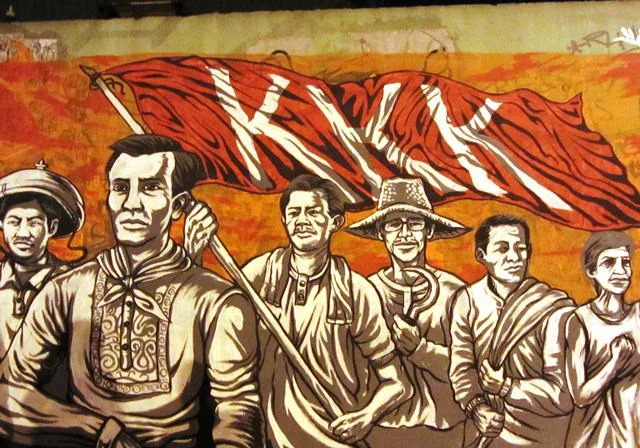
By the late 19th century, Filipino nationalism began to spread in the archipelago. Intellectuals like José Rizal, Andrés Bonifacio, and Emilio Aguinaldo challenged Spanish oppression through writings and revolutionary movements.
Their ideas united the local population across the archipelago, transforming them from colonial subjects into people with a shared national consciousness. Spanish rule finally ended in 1898 following the Philippine revolution and Spain’s defeat in the Spanish-American war. However, the treaty of Paris transferred control of the Philippines to the United States, marking the end of Philippine colonization.
Although Spanish rule had ended, the colonization left a complex legacy. Its cultural, religious, and institutional legacies continued to shape the Philippines well into the modern era. Understanding this period is essential to understand the modern Philippines today. Colonial influences coexist with a strong national identity forged through resistance and adaptation.
References
Wong, J. (2019) Spanish colonial influences on Filipino culture, Medium, 10 October. Available at: https://medium.com/@joshwong.n/spanish-colonial-influences-on-filipino-culture-6859d567042d.
Rafael, V. L. (2019) Colonial Contractions: The Making of the Modern Philippines, 1565–1946. Oxford Research Encyclopedia of Asian History. Available at: https://history.washington.edu/sites/history/files/documents/research/vicente_l._rafael_colonial_contractions.pdf.
Sernau, B. (2025) A confluence of cultures: Spain’s influence on the Philippines, MagellanTV, 23 March. Available at: https://www.magellantv.com/articles/a-confluence-of-cultures-spains-influence-on-the-philippines.